AI Terms Every Product Team Should Know in 2026
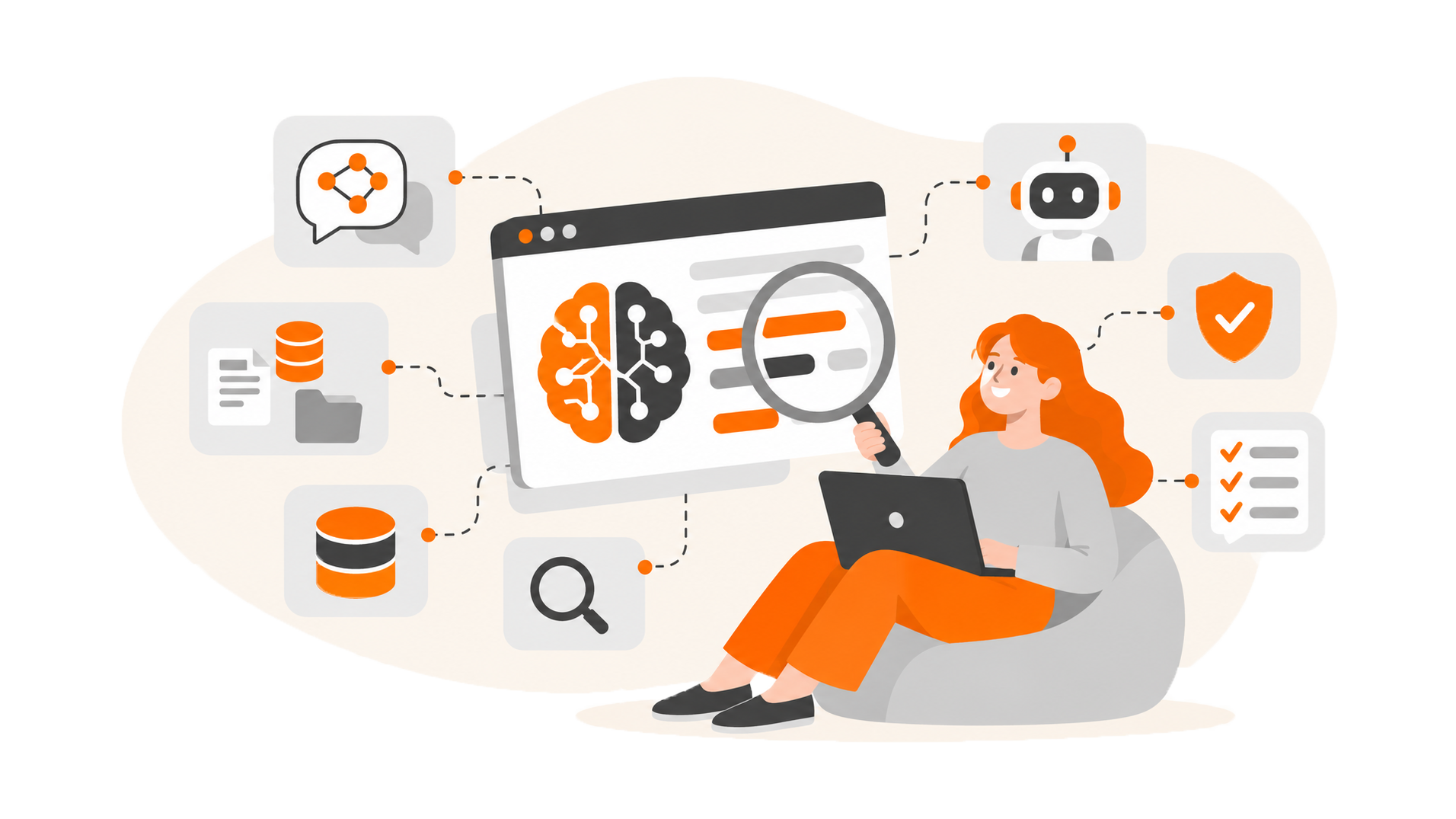
Your vendor says the support bot needs RAG, not fine-tuning, will run on a reasoning model, and will reach your CRM through MCP. Do you nod, or ask what each of those choices does to cost and risk?
AI terms are the shared vocabulary for how artificial intelligence systems are built and run inside products. For a team planning software, about 25 of them cover most vendor conversations. They fall into three layers: model types (LLM, multimodal, reasoning models), the building blocks of LLM features (tokens, inference, vector databases, RAG, fine-tuning), and the agent, safety, and AI-assisted development layer (AI agents, MCP, guardrails, prompt injection, evals, vibe coding). Below, every term gets a plain-English definition and what it means for your budget, timeline, or risk.
Key Takeaways
- About 25 AI terms cover most product and vendor conversations. The same word can describe very different scopes, so pin down the meaning before you compare estimates.
- Most LLM features combine an existing model with your data through retrieval (RAG) and a vector database. Training a model from scratch is rare.
- Bigger isn’t automatically better. Larger context windows and reasoning models add cost and latency with every request.
- AI that acts in your systems needs guardrails, human review, and protection against both direct and indirect prompt injection.
Why AI vocabulary matters for your project
AI terms are stretchy. In one proposal, an “AI agent” is a chatbot that answers FAQs from a script. In another, it’s a system with write access to your CRM that sends emails on its own. Same word, very different scope, budget, and risk.
The same goes for model choices. “We’ll fine-tune a model” describes a training project with its own data pipeline. “We’ll use RAG” describes an integration on top of an existing model. If you don’t know which one a quote assumes, you can’t compare two quotes fairly. A shared vocabulary turns vague AI ideas into requirements your team can estimate, test, and sign off.
Foundational AI terms and model types
You don’t need the maths. You need the boundaries between these concepts and what each choice implies.
| Term | What it means | Why it matters to you |
|---|---|---|
| Artificial intelligence (AI) | Software that performs tasks that normally need human judgment, such as understanding text or images. | An umbrella term — ask which specific technique a proposal uses. |
| Machine learning (ML) | A subset of AI that learns patterns from data instead of hand-written rules. | Needs enough clean, relevant data to work. |
| Deep learning | ML built on multi-layer neural networks; powers modern speech, vision, and language models. | Powerful, but compute-heavy and harder to explain. |
| Generative AI | Models that create new text, images, code, or audio rather than only classifying data. | Fits content, search, and assistant features. |
| Large language model (LLM) | A generative model trained on huge text datasets (GPT, Claude, Gemini). | Usually used via API and billed per token, so usage drives cost. |
| Multimodal model | A model that works with more than one type of input or output — text, images, audio, or video. | Lets one feature read a scanned invoice or a screenshot without a separate OCR step, but image and audio inputs cost more tokens. |
| Reasoning model | An LLM that works through intermediate steps before answering, trading speed for accuracy on complex tasks. | Better for analysis, planning, and code; slower and pricier per request, so reserve it for tasks that need it. |
Terms for building LLM features
Most AI features in custom software wrap an existing LLM with your data and business logic. These terms describe how that works and where the running costs come from.
| Term | What it means | Why it matters to you |
|---|---|---|
| Prompt | The instructions and context sent to a model. | Prompts are versioned and tested like code; small wording changes can shift output. |
| Token | A chunk of text (about ¾ of an English word) that models read and bill by. | The basic unit of API cost and speed. |
| Context window | The maximum number of tokens a model can handle in one request. | Larger contexts fit more data, but every extra token adds cost and latency to every call. |
| Temperature | A setting that controls how random or predictable a model’s output is. | Low for consistent answers (support, data extraction), higher for creative drafts. Many reasoning models fix this value or don’t expose it at all. |
| Inference | Running a trained model to produce an output. | Inference is your ongoing operating cost, paid on every request. |
| Latency | The time between sending a request and getting a response. | Shapes user experience; chat interfaces usually need answers in seconds, not minutes. |
| Embedding | A numeric representation of the meaning of a text, image, or other content. | Lets software find content by meaning, not just keywords. |
| Vector database | A database that stores embeddings and quickly finds the ones closest in meaning to a query. | The search engine behind RAG; a new infrastructure component to host, secure, and keep in sync. |
| Retrieval-augmented generation (RAG) | Fetching relevant documents and passing them to the LLM along with the question. | Grounds answers in your current data without retraining the model. |
| Fine-tuning | Further training an existing model on your own examples. | Higher upfront cost; suits consistent tone or format, not fresh facts. |
Embeddings, vector databases, and RAG work as one chain:
- Your documents are split into chunks and turned into embeddings.
- The embeddings are stored in a vector database.
- When a user asks a question, the system retrieves the most relevant chunks.
- The LLM is instructed to answer from those chunks. That’s RAG.
RAG reduces hallucinations but doesn’t eliminate them: the model can still mix in what it learned during training or misread a source. That’s why RAG systems still need evals and, for high-stakes answers, human review.
Why not just paste everything into a large context window? Because you’d pay for every token on every request and wait longer for each answer. RAG sends only what’s relevant, which keeps cost and latency predictable as your knowledge base grows.
Agents, safety, and AI-assisted development
Once AI acts instead of answering — updating records, calling APIs, sending messages — the vocabulary shifts to control and risk. Developers are cautious for good reason: 46% say they don’t trust the accuracy of AI output, according to the Stack Overflow 2025 Developer Survey.
| Term | What it means | Why it matters to you |
|---|---|---|
| AI agent (agentic AI) | An LLM-based system that plans steps and uses tools to reach a goal, not just reply to a message. | More automation, but every tool it can call is a permission you must scope and log. |
| Model Context Protocol (MCP) | An open standard for connecting AI applications to data sources and tools. Anthropic introduced it in 2024 and in December 2025 donated it to the Agentic AI Foundation under the Linux Foundation. The official MCP documentation compares it to “a USB-C port for AI applications.” | Vendor-neutral governance lowers lock-in risk, and one integration can serve several AI tools. But each connection widens what the model can reach. |
| Hallucination | A confident output that is factually wrong or invented. | It comes from how LLMs generate text, so you design around it with retrieval, validation, and review. |
| Guardrails | Rules and checks that limit what a model can say or do, such as blocked topics or an approved list of actions. | Your main control for keeping an agent within business and legal limits. |
| Prompt injection | Input crafted to override the model’s instructions. It can be direct (a user types it) or indirect (hidden in a document, email, or web page the model reads). The OWASP Top 10 for LLM applications ranks it as risk number one. | Critical for RAG and agents: any content the model ingests can carry instructions, so treat retrieved data as untrusted. |
| Human-in-the-loop (HITL) | A person reviews or approves an AI decision before it takes effect. | Adds a review step but sharply limits damage from wrong or manipulated outputs. |
| Evals | Repeatable tests that score model output for accuracy, safety, and regressions. | The AI counterpart of a QA and testing process; without evals, you can’t tell whether a prompt or model change made things better or worse. |
| Vibe coding | Building software by prompting an AI coding assistant and accepting what it generates. | Fast for prototypes; production code still needs review, tests, and security hardening. |
How to use these terms with your development team
New Line Technologies has reviewed and shipped 200+ apps through its vibe-coding-to-production work. The same lesson applies when you plan a new AI feature: vague requirements turn into vague estimates. The briefs that produce accurate ones answer four questions:
- What should the AI do? Generate, search, or act. The answer decides between a simple LLM call, RAG, or an agent.
- Which data will it use, and who owns it? This shapes retrieval, the vector database, and compliance work.
- What happens when it’s wrong? Define guardrails, human-in-the-loop steps, and an acceptable error rate.
- How will you measure quality? Agree on evals and latency targets before development starts.
When the AI does get something wrong, treat it like any other defect. Reproduce it, log it with a clear bug report, and add it to your eval set so the same mistake can’t come back unnoticed.
For deeper definitions, see the NIST Trustworthy and Responsible AI glossary. For more explainers like this one, browse our Must Know guides for tech leaders.
FAQs
AI is the broad field of software performing tasks that need human-like judgment. Machine learning is the part of AI that learns from data rather than fixed rules. Deep learning is machine learning built on multi-layer neural networks, and it powers today’s language and vision models.
RAG (retrieval-augmented generation) pulls relevant documents from a vector database at query time and passes them to the model, so answers can reflect current data without retraining. Fine-tuning retrains the model on your examples, which suits a consistent style or output format. Most teams start with RAG because it is cheaper to build and easier to keep up to date.
A hallucination is an AI output that sounds plausible but is wrong or invented. It happens because LLMs predict likely text rather than look facts up. Teams can reduce it with RAG, guardrails, evals, and human review for high-stakes decisions, but can’t eliminate it entirely.
Indirect prompt injection happens when malicious instructions are hidden in content the model reads on its own, such as a document, an email, or a web page, rather than typed by the user. It is a key risk for RAG systems and AI agents. Defenses include treating retrieved content as untrusted, limiting tool permissions, and requiring human approval for sensitive actions.
Start with six: LLM, token, RAG, AI agent, hallucination, and evals. Together they explain what an AI feature does, what drives its running cost, where it can fail, and how quality gets measured. Add guardrails and prompt injection once your feature starts taking actions in other systems.
Not sure whether your AI feature needs RAG, an agent, or just a well-designed prompt? Talk to our team — through our custom software development services, we’ll turn the idea into an architecture and a realistic estimate. Already have a prototype built with Cursor, Lovable, or Claude Code? Our vibe coding to production service gets it ready for real users.