Traditional Waterfall Method
In a world of rapid technological development and agile software development methodologies, it may seem that traditional approaches have lost their relevance. However, the Waterfall Method continues to occupy an important place in the arsenal of modern project managers and developers. Why does this methodology, which appeared over 50 years ago, still remain useful in 2025?
The answer lies in the fact that not all projects require the flexibility of Agile or the speed of DevOps. Sometimes clear structure, predictability, and careful planning are needed – exactly what the traditional waterfall model provides.
What is the Traditional Waterfall Model
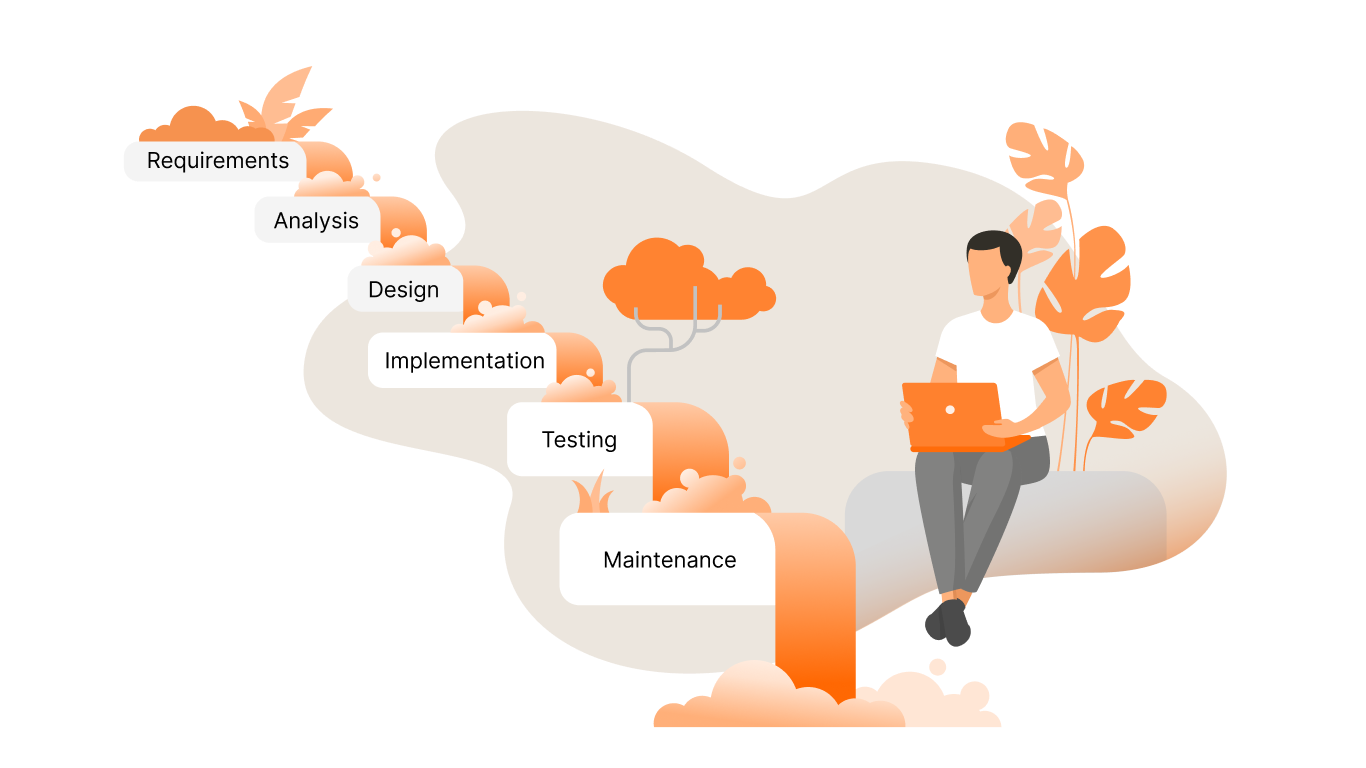
The Waterfall development model is a linear and sequential approach to software development, first described by Winston Royce in 1970. The methodology’s name comes from the analogy with a waterfall: just as water flows from top to bottom and cannot return back, each project stage must be completed before moving to the next one.
The main principle of the waterfall model is that each project phase has clearly defined goals and results. When one phase is completed, the team moves to the next, and returning to previous stages is a complex or impossible process.
This methodology is particularly valued by project managers for its logic and predictability. It allows precise planning of resources, budget, and execution timelines, making it ideal for projects with clear requirements and limited changes.
In 2025, the waterfall model has evolved to include elements of risk management and quality, but its core principles remain unchanged.
Stages of the Waterfall Development Model: A Step-by-Step Overview
The traditional waterfall model consists of five main stages, each with its own characteristics and tasks:
1. Requirements Gathering and Analysis (Requirements Analysis)
This is the fundamental stage on which the success of the entire project depends. At this stage, the project team carefully gathers all customer requirements, documents functional and non-functional needs of the future system.
Currently, this stage often includes the use of modern tools for requirements gathering, such as interactive prototypes, virtual workshops, and AI assistants for analyzing user needs. The main rule remains unchanged: all requirements must be collected and agreed upon at this stage.
2. System Design
At the design stage, the team creates a detailed plan for the future system architecture. This includes technology selection, database schema creation, interface definition, and integration points.
Modern design tools, such as cloud architectures, microservices, and containerization, have significantly expanded the possibilities of this stage. However, the main goal remains the same: create a clear plan that will satisfy all documented requirements.
3. Implementation and Programming
This is the stage when theory becomes practice. Developers write code according to the created design. In the waterfall model, this process should be as predictable as possible, since all decisions have already been made in previous stages.
In 2025, this stage often includes the use of AI programming assistants, automated build and deployment systems, which significantly accelerate the development process while maintaining code quality.
4. Testing and Verification
The testing stage is designed to ensure that the created system meets all specified requirements. In the traditional waterfall model, this is a comprehensive process that includes various types of testing: functional, integration, load testing, etc.
Modern automated testing tools, including AI-driven testing and continuous testing throughout the entire development cycle (continuous testing pipeline), have significantly improved the efficiency of this stage, allowing for faster and more accurate error detection.
5. Deployment and Maintenance
The final stage covers system deployment in the production environment and organizing its further support. Currently, this process is often automated thanks to DevOps practices and cloud technologies, making it more reliable and efficient.
Advantages and Disadvantages of the Methodology in Modern Realities
Advantages of the Waterfall Model:
Clear structure and predictability – project managers can accurately plan resources, budget, and timelines. This is especially important for large corporate projects or government contracts.
Simplicity of management – each team member clearly understands their tasks and expected results. Project progress is easy to track and report to stakeholders.
Thorough documentation – all decisions and changes are documented, optimizing future system support and knowledge transfer to new team members.
Quality control – a systematic approach to testing allows detecting most errors before product release.
Disadvantages of the Methodology:
Inflexibility to changes – the main criticism of the waterfall model is that requirement changes at late project stages are expensive and difficult to implement.
Untimely problem detection – a working product appears only at the end of the project, which can lead to unpleasant “surprises.”
Risk of not meeting expectations – a lot of time can pass between initial requirements and the final product, during which user needs may change.
When to Use It
Despite the popularity of agile methodologies, the waterfall model still has its niche in the modern development world:
Regulated industries – pharmaceuticals, banking, aviation, and other sectors with strict documentation and compliance requirements.
Infrastructure projects – development of critical systems where errors can have serious consequences.
Projects with clear requirements – when all user needs are well-defined and almost unchangeable.
Teams with limited Agile experience – for organizations not yet ready to implement agile methodologies.
Fixed budget and timelines – when the customer needs guarantees regarding project cost and execution time.
Many organizations use hybrid approaches, combining elements of the waterfall model with agile practices where appropriate.
Hybrid Approaches
Modern software development reality rarely fits within the framework of a single methodology. That’s why more and more companies are now moving to hybrid models that allow getting advantages of different approaches.
Water-Scrum-Fall – one of the most popular hybrid approaches, where planning and requirements analysis occur according to waterfall principles, development is conducted in sprints according to Scrum methodology, and testing and deployment return to the waterfall model. This is especially effective for large corporate projects that require careful preparation but need flexibility during development.
Phased Agile involves using waterfall principles for high-level project planning (defining main milestones and stages), while agile practices are applied within each phase. For example, requirements analysis may last 2-3 months according to the waterfall model, and then development is conducted in short iterations.
Documentation-Driven Agile combines thorough requirements documentation (characteristic of Waterfall) with iterative development. This is critically important for projects in regulated industries where documentation is mandatory, but flexibility in implementation is needed.
The key to success of hybrid approaches is understanding which elements of each methodology best suit specific project stages. For example, requirements gathering for medical equipment is better conducted according to waterfall methodology principles, while interface development should follow Agile principles.
Conclusions
The traditional waterfall development model is not an outdated methodology, but a reliable tool for certain types of projects. In 2025, it continues to evolve, integrating modern technologies and practices while maintaining its main advantages: structure, predictability, and control.
Project success depends not on the “trendiness” of the methodology, but on its correspondence to the task specifics, team, and organizational context. The waterfall model remains an excellent choice for projects where stability, documentation, and phased quality control are important.
Main advice: don’t blindly follow fashionable trends in methodology selection. Analyze your project, team, and constraints, then choose the approach that best suits achieving your goals. Sometimes the good old method may turn out to be exactly what’s needed for your project’s success.