QA, QC, and Testing Explained for IT Careers
You might have heard the QA, QC and Testing terms, which are used in IT or when you are just beginning your career in the software development sphere. Doesn’t it appears like everybody is talking these words as synonyms? These are actually three totally different concepts and the knowledge of the difference can greatly influence the quality of your work and team performance.
Having more than 10 years of experience in applying the quality assurance processes within the IT companies, we understand that the misunderstanding of these terms results in the inefficient distribution of resources and low quality of Software Development Life Cycle (SDLC). We will need to determine what and why it is essential to every specialist to know.
What is Testing?
Testing refers to the process of testing software to detect defects and ensure that the product is functioning as intended.
We can begin with the most basic one. Suppose you have purchased a new smartphone. The initial step is to check whether the camera is functioning, whether the battery can be charged, whether the touch screen is responsive. You are testing a complete product.
When a tester clicks on an application and begins to press buttons, typing in data, verifying different usage conditions – that is testing. The research conducted by the World Quality Report found out that organizations use an average of 23% of the overall IT project budget on testing and that is why it is of great importance in the development process.
The most important features of testing:
- Determining the flaws and faults in the completed product.
- Gathering statistical information concerning quality.
- Documenting found issues
- Checking conformity to functional requirements.
- Carrying out automation testing to do regression testing.
In simple terms, testing answers the question: “Do we have what we created work?
What is Quality Control? Measuring Results
Quality Control (QC) refers to a controlled procedure of checking and reviewing different areas of a project to ascertain quality standards.
Now let’s move up a level. When testing is an instrument, quality control is the whole workshop consisting of tools. QC is also not limited to testing but also code review, metrics analysis, documentation validation and so much more.
To the smartphone analogy. QC does not mean checking whether the phone is working. It is the procedure that every batch of phones is inspected at the factory by meeting the standards: is the body thickness the right one, does the color correspond with the stated one, does the device pass drop tests.
Quality control in the software quality world incorporates:
- Testing (as the main tool)
- Reviews and code inspections.
- Documentation audits
- Requirements validation
- Quality metrics analysis
- Monitoring adherence to standards in CI/CD pipeline.
Case: a development team is developing a mobile banking application. A QC specialist does not only test the money transfer functionality but also ensures that all the security requirements are met, examines whether the technical documentation is formatted correctly, monitors that the code review has been passed, verifies whether the test results are acceptable.
Quality Control questions it: “Is the result of quality?
What is Quality Assurance? Problem Prevention
Quality Assurance (QA) is a proactive activity of designing and streamlining systems and approaches that ensure that defects do not emerge at any point in the development process.
And the most interesting now – QA. It is the most general notion of the three, and here is where the confusion is most likely to occur. QA is not about identifying mistakes in a completed product but it is about how to establish processes that reduce the number of mistakes.
Imagine a doctor. Diagnosis is curing an illness that already exists. QC is periodic examinations and tests. And QA is healthy lifestyle, proper nutrition and preventance so that the disease does not take place at all.
Quality assurance is concerned with:
- Streamlining development (Agile, Scrum, DevOps)
- Setting of standards and methodologies.
- Education of the staff on best practices.
- Application of automation testing structures.
- Incorporation of quality in CI/CD.
- Constant process enhancement.
IBM statistics of IEEE Computer Society show that for a company investing in the QA procedures during the initial development phases, 40-60 percent less defects in the final product are detected than in companies that invest in the testing of the final product only at the end of the development life cycle.
Case: Netflix is known to have an approach to QA. They do not just test all the features until the release – they have developed a whole culture of quality. They have a tradition known as Chaos Engineering, in which they intentionally introduce issues into the production environment so that the system can be able to handle any failures. It is a typical QA thinking: we are not going to wait until something goes wrong but rather prepare in advance.
Quality Assurance provides the answer to the question: Are we planning the process of producing a quality product in a proper way?
Comparison: QA vs QC vs Testing
In order to get a quick idea of what the difference is, here is a short overview:
| Aspect | Testing | QC (Quality Control) | QA (Quality Assurance) |
| Role | Conducts checks on the completed product | Manages outcomes and the process of creation | Provides quality-creating processes |
| Main Question | “Does it work?” | “Is it up to standards?” | “Do we do the right thing?” |
| When | Once functionality is developed | During the whole process of development | In every stage, including the planning |
| Focus | Detecting defects | Keeping track of adherence to needs | Defect prevention |
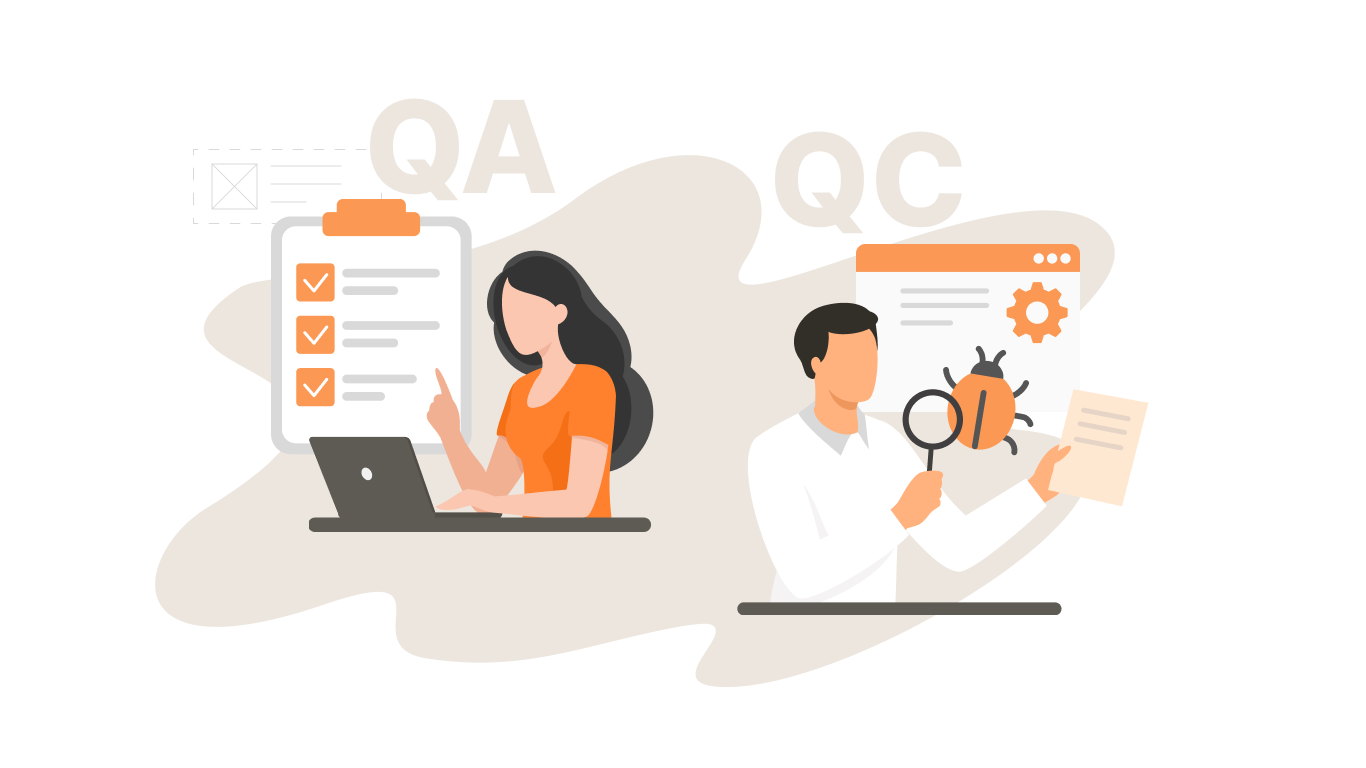
Hierarchy of concepts:
- Testing – one of the tools used in Quality Control (QC).
- Quality Control (QC) – a component within Quality Assurance (QA).
- Quality Assurance (QA) – the broadest concept, focused on creating and maintaining product quality in all aspects.
Collaboration: Some Applied DevOps
Having analyzed all the concepts individually, it is time to observe how they interact in the real world in the Devops and CI/CD era.
The creation of a Food Delivery Mobile App
QA (Quality Assurance):
- Establishes the standards of development at the beginning of the project.
- Selects approach (e.g., Agile/Scrum)
- Defines Definitions of Done and code review.
- Conducts training teamwork in terms of new tools and frameworks.
- Automates CI/CD pipeline.
QC (Quality Control):
- Reviews/analyzes sprints and metrics regularly.
- Checks adherence to set standards.
- Examines test coverage (test coverage measures)
- Authenticates API documentation and technical specifications.
- Results of automation testing in controls.
Testing:
- Checks Special functions: adding food to cart.
- Payment system integration and tests payment.
- Checks push notifications and their timeliness.
- Courier location map test.
- Conducts regression testing on a post release basis.
Quality in the Software and Automotive Industry
Tesla is a good example of the combination of all three concepts:
Quality strategy: The development of continuous integration, architecture to support OTA updates (over-the-air), the introduction of an innovative and experimental culture.
QC: Comprehensive inspection of every part in the factory, gathering telemetry on car sensors in the field, performing quality measurements of batteries and engines.
Testing: Physical crash tests, millions of kilometers of autopilot simulator tests, testing every software version before it is rolled out to the full fleet.
Why is This Important to the Reality of Modern DevOps?
The distinction between QA, QC, and Testing is of paramount importance to proper work, particularly during the times of DevOps, CI/CD, and fast releases. In case a team mixes up these notions, grave issues are raised:
Misplaced resources: A firm engages a so-called QA engineer, who is supposed to optimize the processes and introduce automation systems, yet he/she does nothing but manual testing.
Rather than being proactive: Reactive approach implies that you are merely treating symptoms but not removing causes of issues in the Software Development Life Cycle.
Poor communication: When a manager requests them to make it better in QA, other team members might take this in different ways – recruiting testers, re-engineering the whole development process.
Wasted optimization opportunities: The companies lack the knowledge of QA in the sense that it does not take the benefits of automation testing, does not incorporate quality into CI/CD pipeline, and does not establish a quality culture within the group.
A clear knowledge of such roles, according to information provided by the International Software Testing Qualifications Board (ISTQB), one of the most successful certification bodies in the world in software testing, boosts team performance by 30-35 percent.
Conclusion
Quality Assurance, Quality Control and Testing are not synonyms but three stages of quality assurance of the products:
- Testing is done to test the completed product and detect defects.
- QC regulates the process of creation and standard compliance.
- QA develops a system of processes that incorporate high quality as an inherent aspect of the development.
And you are a tester – you are doing very important work of finding defects. And, in case you are a QC specialist – you are checking software quality throughout every step. In case you are a QA engineer – you are an architect of process that can make quality possible using DevOps practices, automation testing, and continuous improvement.
In today’s world, where software surrounds us everywhere—from smartphones to cars, from medical equipment to banking systems—understanding how to ensure quality at all levels is becoming not just a professional skill, but a necessity. And now you know the difference.
Don’t just test – guarantee quality. Whether you need expert quality control process configuration, a full quality control audit, or seamless integration of automated testing into your CI/CD pipeline, our certified team is ready to help. Contact us now to improve your product quality and team efficiency today.